
Eagle County Aviation Association Fall Roundup - Oct 13 Saturday Wings Event and Fly-In At Eagle
Come join the ECAA for a fun and informative Saturday October 13th morning event at Eagle County Regional Airport. This morning of aviation is free to all. Landing and facility fees will be waived for aircraft flying in for the event. The event will qualify for Wings credit if you register through FAASafety.gov.
The event will start at 9:00 AM in Terminal B - Adjacent to the Vail Valley Jet Center. If you are arriving by plane just park at the Vail Valley Jet Center and come inside. If arriving by car park outside the fence near gate 4, in front of the Vail Valley Jet Center and the Jet Center will buzz you through the gate. For questions on the event call Loren French - 970-401-5105
Agenda:
9:00 AM – 10:15 AM - Presentation by Bob DelValle, Operations Pilot for the Steamboat Springs office of the Civil Air Patrol
With 16 years in CAP. Bob will be talking about CAP's mission, the SAR process, and how a pilot can make it easier for CAP to find them as well as some considerations for winter survival as we approach the cold months. There will also be an opportunity for question and answer. This presentation will qualify for wings credit. Doughnuts and Coffee will be provided by Alpine Flight Training.
10:15 AM – 10:45 AM - Where’s Waldo
Bring you’re flight computer and you’ll have a chance to test your skill at determining the whereabouts of a lost aircraft. You’ll get the pilot’s flight plan, weather information, data about his aircraft and clues about his route. You’ll need to calculate where he likely ran out of fuel. There will be a prize for the first correct answer or the coordinates closest to the position.
10:45 AM – 12:00 Noon - Ed Nelson, American Champion Dealer
Presentation by Ed Nelson, the American Champion dealer in Sidney Nebraska will have several aircraft here to see, a High Country Explorer and a Super Decathlon. Following his presentation he will be giving demo rides in the High Country Explorer and instruction in the Super Decathlon. Also after the presentation during lunch you’ll have a chance to look at the planes up close.
12:00 Noon – Lunch Provided by Eagle County Aviation Association
The Eagle County Aviation Association will be providing lunch. Grilled hot dogs, chips, soda.
This event is sponsored by: Denver’s FAAST Team, The Steamboat Springs Civil Air Patrol, The Vail Valley Jet Center, The Eagle County Aviation Association, and Alpine Flight Training.

Gold Seal CFI at Eagle County Regional Airport
Loren French of Alpine Flight Training, located at Eagle County Regional airport recently achieved the distinguished Gold Seal from the FAA as a result of a perfect pass rate on checkrides over the last 2 years. Congrats Loren, good job!
John Haerter of Vail Colorado Receives Pilot Pilot's License
Congrats to John Haerter of Vail Colorado who received his Private Pilot's License here at Alpine Flight Training. John is the 10th pilot this year to receive their license or rating at Alpine Flight Training this year.
New Pilot: Mike Bennett - Pilot Training, Eagle & Edwards Colorado
Congrats to Edwards Colorado resident Mike Bennett. Mike completed his training and checkride for Private Pilot Airplane Single Engine Land yesterday in Crawford, Colorado. Mike learned to fly at Eagle County Regional Airport through Alpine Flight Training in N542DC, a Diamond Katana. Welcome aboard Mike!
Alpine Flight Training is based in Eagle Colorado and offers training for private, instrument, commercial and CFI, CFII and ATP ratings. Come visit us or give us a call for more information.
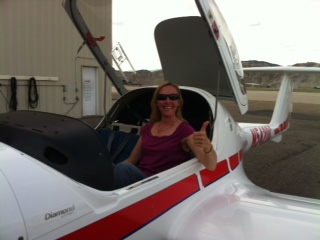
Patricia Lee Completes Private Pilot License
Edwards resident Patricia Lee yesterday completed her Private Pilot's License. Congrats to Patricia. The designated pilot examiner was gushing over how well Patricia performed the maneuvers and how well she was prepared for the checkride. Certainly all her hard work and long hours of study paid off.
Patricia completed all of her flight training here at Alpine Flight Training in Eagle Colorado in the Diamond DA-20-C1 Katana Evolution.
Alpine Flight Training - Public Event April 10, 2012
Tuesday April 10th, 6PM, the Eagle County Aviation Association will be holding it's semi-monthly meeting at the Vail Valley Jet Center - Terminal B. Alpine Flight Training's own Loren French will be the featured speaker. Members and non-members are invited. There will be refreshments provided by the Eagle County Aviation Association. The topic of the meeting will be a fun and educational session from one of our own flight instructors.
Enhance your flying with iPad
Learn how the iPad can enhance your planning, awareness, safety and efficiency in this interactive session.
Tuesday, April 10, 2012 , starting at 6:00 pm
Speaker(s): Loren French, CFII/MEI/ATP, Alpine Flight Training
This interactive session will be fun and educational for novice and seasoned pilots both instrument and non-instrument rated. We'll look at how the iPad can enhance your flight planning, situational awareness, safety and efficiency. As we tour different airspace on the iPad we'll also review regulations, equipment requirements, chart symbols and various applications and add-on devices for the iPad. We'll use the iPad to gain insight to every type of airspace including MOAs, Restricted airspace, controlled, and uncontrolled. We'll review airspaces and regulations for each as we tour the USA on the iPad. We'll also look at weather resources and flight planning for both IFR and VFR on the iPad. The presenters iPad will be connected to projection system, you can bring along your iPad if you desire to follow along.
Vail Valley Jet Center - Terminal B
871 Cooley Mesa Road
Terminal B
Gypsum, CO 81637
Directions to Venue:
Park outside the fence in the parking area near the Vail Valley Jet Center. Enter through Gate 4 (the walk through gate), enter the Vail Valley Jet Center and proceed straight through to the Terminal B area.
Credit Applicability: 1 Credit for Basic Knowledge Topic 3
Cody Messer completes Private Pilot Training at Alpine Flight Training
Today Cody Messer or Carbondale, Colorado received his Private Pilot License in Airplane Single Engine Land. He took the checkride earlier today in Crawford Colorado in N542DC - a Diamond DA-20-C1 Katana Evolution. Congratulations Cody!
Grand Canyon Special Airspace | Flying the Grand Canyon
An online safety program about the Grand Canyon Special Airspace
Here's a neat program about the Grand Canyon Airspace. It's a great 49 slide program greatly detailing all the information about the Grand Canyon Airspace. It explains all the altitudes, the GA corridors, and the FAR 93 requirement to monitor the specific frequencies. It's loaded with lots of pictures, charts, and even some basic video type effects. At the end, it allows you to print a certificate and qualifies as the classroom safety portion of the FAA Wings Program. This would be a really great review for any pilots that ever take trips in that direction.
See Also
- National Interagency Airspace (Forest Fire Fighters)
Welcome to the National Interagency Airspace Information website
Rod Egizii Received Commercial Pilot's License
Today, March 5th, 2012 Rod Egizii of Edwards, Colorado received his Commercial Pilot's License. Training for the checkride was performed at Alpine Flight Training in the Cessna Cardinal 177-RG. The checkride was completed at Crawford, Colorado. Way to go Rod! Congratulations!