
Private Pilot Ground School - January 2014 @ Eagle Airport
Upcoming Event
JANUARY: PRIVATE PILOT WRITTEN TEST PREP WEEKEND GROUND SCHOOL
Saturday & Sunday, Jan 11th & 12th, 2014
Vail Valley Jet Center
On the weekend of January 11th and January 12th there will be an accelerated private pilot test prep ground school at the Vail Valley Jet Center. The class is two days long, 8 hours each day, and is designed to help a student overcome a major hurdle of pilot training - the preparation for the written test. The information on the private pilot test prep will be presented in lively and interactive way by a team of instructors. The class will be limited to 10 participants. You will receive the endorsement to take the written test after attending the class. The class runs 8AM to 5PM both days, lunch will be provided, books and materials are included the cost is $299. To signup or for questions contact Loren French at 970-401-5105.

Vail Air Tours
Fun Scenic Flights
Witness the incredible scenery of the Colorado high country. Our tours will take you to some of the most incredible features in the area including the Vail Valley, Gore Range, New York Range, Glenwood Canyon, Mt. Sopris, Colorado River Valley, Castle Peak, Mt. of the Holy Cross, Red Table Mountain and many more places.
Hunt Scouting
Preparing for a hunting trip? We can help with an aerial scouting flight. You’ll get a great perspective on your hunting unit.
Real Estate
Get a better view of that mountain ranch you’re considering purchasing.
Call (970) 401-5105 to schedule an air tour.
Fly the Colorado Rockies
Safe and enjoyable flying in the mountains requires the right perspective, solid understanding of aircraft performance, the operating environment and most importantly, your abilities as a pilot. The proficient mountain pilot will carefully assess each of these factors when planning a mountain flight.
There are several fundamental concepts that we teach, most other concepts are related to these five key concepts:
- Route Planning
- Aircraft Performance
- Effects of Wind over Terrain
- Positioning of the Aircraft in Relation to Terrain
- Survival Concepts
We offer single and multi-day courses for mountain flying.
Learn to fly in Glenwood Springs, Colorado
From Glenwood Springs, Colorado - Eagle County Regional Airport is a short 30 minute drive. Alpine Flight Training offers the the most well maintained and affordable aircraft rentals and instruction in the western slope and central rockies of colorado. A short drive from Glenwood, Aspen, Carbondale, Silt, Alpine Flight Training is your source for learning to fly in Glenwood Springs, Colorado.
Accelerated Instrument Finish-up Course
If you are partially through your instrument rating and looking for a fast finish-up course Alpine Flight Training can help. We have instructors that focus on accelerated instrument training and we can build a course specific to your needs to get you through the remining training and checkride. To begin the process call (970) 401-5105 to schedule an initial consultation. We'll determine where you were in the training and build a customized plan to get your training completed.
We offer training in your aircraft or ours. Additionally, we can combine your instrument training with mountain flying instruction to make the most of your time and money.
7 Day Instrument Rating in Colorado
Get Your Instrument Rating in 7 Days! – Accelerated Instrument Rating Training from Alpine Flight Training
Our program is Structured, Efficient, & Cost Effective, you may fly your own aircraft or we have your choice of a Diamond DA-20 or Piper Archer II to use for your instrument training.
As part of the training, you’ll have the benefit of getting mountain flying experience, and learn real-world instrument flying while flying cross country in the western US. You’ll get 7 days of individualized experience for your training investment while you gain real confidence working the IFR system with typical GA routes. Our instructors include extremely knowledgeable Gold Seal and Master CFI’s as well as former airline captains.
If you’re a non-instrument rated pilot, you have undoubtedly experienced the frustration of canceling flights due to low ceilings or poor visibility. Yet you know that just above that shallow low overcast lie clear blue skies and great flying weather!
All you need is your Instrument rating. With the skills you’ll develop in instrument training, you’ll be able to control your airplane and navigate all the way to your destination without outside visual references, solely by reference to the flight instruments. The Instrument rating will open up many more opportunities for you to fly without being grounded by weather. And in the process, you’ll become a more accurate and more proficient–and thus safer–pilot, even when the weather is VFR.
If you’re interested in getting your instrument in 7 days, this is the program for you. There are no tricks to this, the training is hard work, and requires your full attention and dedication to the work. When you’re finished, you will have gained solid experience IFR Experience. As part of your training wou will receive at least 30 hours of one-on-one flight instruction , you’ll fly at least 25 approaches during the program, many with SID’s STAR’s and holding patterns. You’ll be amazed at how much you will learn. When you are not in the air, you will learn techniques that will simplify otherwise complex procedures such as procedure turns, holding pattern entries and many others.
Mountain Airports - Serious About Snow Removal
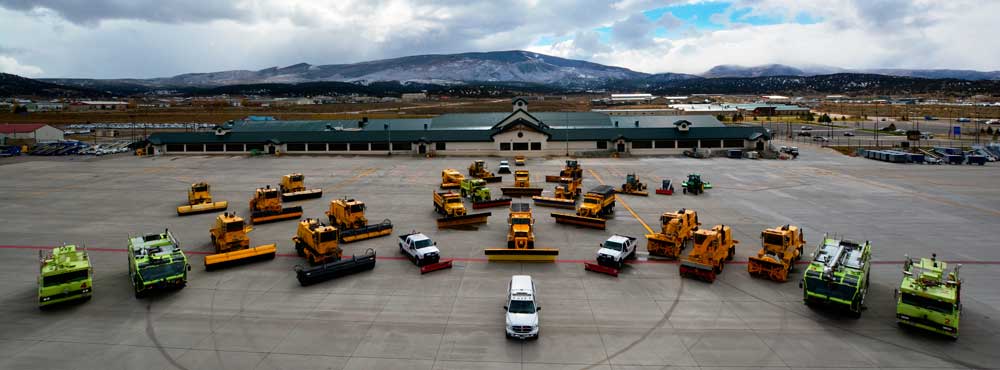
A cool photo taken a couple days ago here at Eagle County Airport - shows all the snow removal and emergency equipment at Eagle Airport. I suppose quite a feat to get it all running at the same time, I imagine with this many trucks and tractors something would always be broke. In any case, the airport is ready for winter, when those rouge Colorado Mountain Storms come through then team at Eagle County Regional Airport is prepared to clear the runway and taxiways in minutes.
A clean runway is ideal, however there are some strategies we teach pilots to use when landing at airports where the snow clearing may not be as swift and thorough as it is here at Eagle Airport - minimal use of brakes, maximum aerodynamic braking, steering primarily using airfoils and not wheels, maximize your available runway distance and utilize the slope of the runway and wind will help you make a safe landing if the conditions are ice and snow covered runway braking action nil.
Mountain Flying Video 1
Just wanted to share a brief educational video we produced at our flight school earlier this week about mountain flying, this is the first module of 5 planned units we're going to put into youtube on the fundamentals of mountain flying. Would like to hear some feedback on the unit.
Mountain Flying Ground School - Part 1: Route Planning
Accelerated Private Pilot Training in Colorado Rockies
Our accelerated Private Pilot Certificate program will take you from zero hours of flight experience through earning your first pilot certificate in as little as 21 days. The program includes both flight training and ground instruction. Our primary goal is to ensure that you become a safe and competent pilot–not just that you know enough to pass your FAA practical test. During the accelerated private pilot training you’ll be learning to fly in the heart of the Colorado Rockies, so you’ll not only become a safe and competent pilot, but also a safe and competent mountain pilot. Alpine Flight Training provides all private pilot training in a late model DA-20 Katana Evolution. You’ll fly from a controlled airport each day and visit a variety of other controlled and uncontrolled fields in the vicinity.
Runway Safety and Pilot Controller Forum Nov 29th
Eagle Airport (EGE) - Local Runway Safety Action Team
November 29, 2012 10:00AM
Vail Valley Jet Center – Terminal B
871 Cooley Mesa Road - Gypsum, Co. 81637
This is a great opportunity to get answers to a variety of aviation topics. In attendance will be the following aviation professionals to answer your questions:
- Milton Souza – EGE Tower - Air Traffic Manager
- John Botkin – EGE Tower – Air Traffic Controller
- Yancy O’Barr – Denver TRACON Staff Manager
- Greg Phillips – Eagle Airport – Airport Director
- Bill Ponder – Eagle Airport – Operations Manager
- On hand will also be a representative from the FAA Safety Team, the Denver FSDO and local Flight Instructors.
Meeting Agenda
Welcome and Opening Remarks - Air Traffic Manager
Airport Status - Airport Operations
- Drivers training program
- Current and Planned Construction projects
- Security and airfield access
- Other local issues
Runway Safety Program Overview - Air Traffic Manager
- Runway Safety Presentation
- Review of past Runway Incursions
- Review of Previous Action Items
Pilot – Controller Forum
John Botkin, Controller, Eagle Tower
- Discussion about airport procedures communications, runway crossing, and phraseology.
- Discussion on peak traffic days, winter operations, winter runway reporting.
Loren French – Denver FAAST Team
- Discussion on risk management related specifically to wake turbulence and winter operations at Eagle Airport.
Customer Concerns and Comments
- All Participants
Draft Action Plan
- All Participants
Attendance at this event will provide wings credit if you register through faasafety.gov.