
Aircraft Rental in Vail Eagle Colorado
If you're just visiting Vail, Glenwood Springs, or the Eagle Valley give us a call. We'll set up a flight with one of our instructors to show you mountain flying first hand. One the most popular trips both summer or winter is a flight to Leadville or Telluride. Leadville Is The highest airport in north America and Telluride is the second highest airport. Both flights provide an excellent scenic experience that combines enjoyment and learning.
Alpine Flight Training offers pilot training and aircraft rental in the Vail Valley. Our aircraft is a Diamond DA-20 Eclipse, commonly referred to as a Katana and is the later generation of the tried and true Katana aircraft. The original Diamond DA-20 Katana was equipped with a 90 hp Rotax 912 engine. The Eclipse version we have at Alpine Flight Training is the C1 model equipped with a 125 hp Continental IO-240 that delivers excellent performance especially useful for Mountain Flying. Our Katana Eclipse, with it's larger engine delivers similar takeoff distances as a Cessna 172 SP, but provides superior climb performance, a faster cruise speed, and a fuel burn nearly 1/2 that of the Cessna 172 SP and a slower landing speed. The Katana was originally inspired by european glider design, and also features superior glide performance of 22:1 compared to the 17:1 glide ratio of the Cessna 172 SP as well as excellent visibility through it's bubble canopy design.

Learning to fly in the winter
I am frequently asked what the best season is to learn to fly. Often I see people that want to learn to fly put it off because they think winter is a bad time to fly.
Nothing could be further from the truth. Winter is an incredible time of year. The cold air means dense air, and that means great performance from our airplanes. The planes climb faster, cruise faster and the engine cooling issues of the summer vanish. It's true, the occasional winter storm grounds us, but that's no different then the thunderstorms that ground us throughout the summer. Even with the winter storms, we can still fly on average six out of every 7 days.
What's more, winter creates an incredible winter landscape. One of the most incredible sights is flying over the snow covered rocky mountains under clear skies and a full moon.
Here in the Rockies, every season presents a unique set of challenges and opportunities Flight training in the spring often brings good weather and brisk winds. Training in the summer is marked by beautiful mornings and warm weather that later turns to afternoon thunderstorms. In the fall we see the beginning of winter storms, but great fall colors and many smooth days. And finally, in the winter we have an incredible landscape, ample smooth flying days.
No matter what the season, it's always a great season to learn to fly in the Colorado Rockies. To learn more about flight instruction call one of our instructors at Eagle Airport
Learn to Fly in Glenwood Springs Colorado
Glenwood Springs Colorado is a great place to learn to fly. You get a blend of aviation old and new. The Glenwood Springs Airport, located a couple miles south of town is a small 3300 foot runway that shows you the way airports used to be. One of the great things about Glenwood however is there are the larger more modern airport Eagle located just 10 minutes away. A new student learning to fly has tremendous opportunity in Glenwood Springs. They can learn to navigate to and from a true mountain airport like Glenwood, but still be able to learn about tower communications, controlled airspace, and have a 9000 foot long runway that is ample wide to practice landings on.
Alpine Flight Training provides flight training and flight instruction at the Glenwood Springs airport for Private and Instrument ratings. If you have ever wanted to learn to fly, start now. Give our knowledgeable instructors a call and we will schedule an introductory flight today. (970) 401-5105
A great show... Wings and Wheels 2011
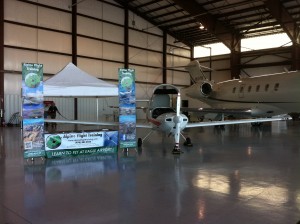
This weekend we had a great turnout for Wings and Wheels. Not only were there more cars, more plane, and more exhibits, but also more visitors and the ramp was bustling with activity. A job well done goes to the Vail Valley Jet Center for putting together a spectacular event and well organized. Below is a photo our our booth that was beside the Challenger 300 that people could look inside.
2nd Annual Wheels and Wings this Weekend
Come visit the 2nd annual Wheels and Wings show this saturday at Eagle airport. Alpine Flight Training will be there with an aicraft on display.
Second Annual Wheels and Wings Show, September 10-11, 2011
The most comprehensive auto, aircraft and motorcycle show in Western Colorado, the Wheels and Wings Show features an unparalleled display of machinery. With over 200 cars, 30 airplanes and other aircraft and 30 motorcycles, the 2011 show will amaze, entertain and blow you away.
10 am Gates open to the public
10 am to 12pm Aircraft, car and motorcycle judging
10:15 am Helicopter and Airplane rides commence
12:30 pm Winners are marked with ribbons
1 pm Winners are lined up for presentation
1:30 pm Award Ceremony
2:30 pm Last helicopter and airplane rides
3 pm Gates close
Flight Icing and Mountain Flying
An important topic for flying in the Colorado Rockies, so today I figured a post on fight icing is in order as we enter the fall and winter when the season and conditions for flight icing is ideal. I'm watching it snow on the mountain tops and my flight lessons for the day have been canceled due to inclement weather.
In-flight icing represents a severe threat to the safety of general aviation aircraft. The handling qualities and capabilities of any aircraft can be negatively affected by ice; however there are strategies a pilot can use to minimize the risks associated with in-flight icing. These steps include preflight planning and analysis to avoid icing conditions, detecting conditions which may result in icing, formulating a plan to exit icing conditions, and dealing with degradation in handling and performance.
Below is my summary, with pieces taken from a variety of sources. If you want to know more, another good resource is the "Pilot's Guide to Flight Icing", this is a CD-ROM available through the NASA Glenn Research Center for a nominal shipping charge.
For many pilots the term “In-Flight Icing” conjures up thoughts of terror in the cockpit when being caught off-guard by unexpected icing. In reality, in-flight icing can be a very severe threat to any aircraft, especially general aviation aircraft. Eventually, even pilots who embark under ideal conditions each flight will eventually find themselves in an icing situation. There are steps a pilot can take to minimize the risk associated with icing both before, and during flight. This paper will use the SHEL Model to examine various aspects of in-flight icing. If you're not familiar with SHEL, the basic perspective is that we can examine any aerospace system in terms of Software, Hardware, Environment, Liveware - essentially... the equipment we have (hardware), the procedures we follow including integrated (software), the flight environment (environment) and the human equation (liveware).
We'll also look at the types of ice and their associated weather (Environment), detection & protection equipment (Hardware), procedures for dealing with icing conditions (Software), and modifications of pilot behavior which will result in a better approach to minimizing icing risks (Liveware). (Nasa, 2002)
Types of Ice (Environment)
In-flight icing can be categorized into two main types based on the conditions required to produce the ice. These two types are structural icing and carburetor icing. Carburetor icing refers to the buildup of ice inside the carburetor venturi due to the condensation and freezing of moisture contained in air as it undergoes evaporative cooling while vaporizing fuel. Severe carburetor icing can result in engine failure due to blockage of the air/fuel mixture into the engine. Structural ice refers to adhesion of ice to the aircraft due to an aircraft surface at or below freezing combined with flight into conditions with visible moisture. (Craig, 1997)
Although carburetor ice is a fairly narrow topic, structural icing can accrete on and affect a broad range of aircraft systems and components. These include wings and control surfaces, air intakes, pitot static instrument sensors, windshields and propellers. Structural ice can produce a variety of problems including decreased wing efficiency and lifting, decreased functionality of control surfaces, blockage of air to the engines, malfunction of airspeed indicator, and reduced visibility through windshield. (Craig 1997)
There are several classifications of structural ice; clear, rime and mixed. The most insidious form of structural ice is clear ice. Clear ice results when large super-cooled liquid water droplets strike an aircraft surface which is at or below freezing. This results in the water creating a coating of ice where it came in contact with the aircraft. With clear ice the freezing of the water occurs slowly, and the super-cooled water will smear towards the rear of the aircraft as the water progressively freezes to the surface. Clear ice is considered the most dangerous form of ice because of the speed at which it can accrete on an aircraft combined with the weight the ice can add as well as the fact that the ice accretes in areas where de-ice or anti-ice equipment cannot provide protection such as the top and bottom of the wing. (Padfield 1994) (Lester, 1997)
Rime ice is a much more common form of ice, and is much less dangerous. Rime ice forms when the aircraft is flying through visible moisture and small particles of snow or water adhere to the aircraft. Rime ice will generally add little weight to the aircraft, and usually accretes in areas protected by de-ice and anti-ice equipment. Rime ice also generally accumulates at a slower rate than clear ice and thus allows pilots time to escape. (Padfield 1994)
The third form of ice is mixed ice, and that is exactly what it is, rime ice mixed with clear ice. The type of ice an aircraft may encounter is predominately a function of temperature and the size of the water droplets in the atmosphere. Clear ice is generally found in temperatures of 0c to -10c and in an atmosphere where the droplets are large. Rime ice is generally found in temperatures between -10c and -40c in atmospheres where water droplets are small or the moisture is in snow form. Between these ranges of temperatures and ranges of moisture particle sizes there is a transition zone where the combination of clear ice and rime ice can coexist forming mixed ice. (Padfield, 1994)
The conditions necessary to produce icing cannot be observed from the ground, and therefore icing in general is very difficult to predict. The meteorologists at the National Weather Service use a series of computer models to forecast icing based on temperature, relative humidity, the dewpoint and dewpoint spread. Based on the specific scenario an icing forecast may be issued with an indication of the probability of icing. The various models used from region to region error on the side of safety by generally over forecasting icing. Because forecasting icing is difficult the National Weather Service heavily relies upon pilot reports to supplement their forecasts. Pilot reports of icing is the factor that changes mere “Forecast Icing Conditions” to “Known Icing Conditions.” This distinction will become important when we discuss aircraft capability and certification. (Nasa 2002)
As stated earlier, the droplet size and the temperature have the greatest impact on what type and severity of ice we can expect. By knowing the conditions ideal for each type of ice to form we can apply these criteria to specific weather scenarios. Clear ice requires large drops of super-cooled water, and is most commonly found in thunderstorms and cumulus clouds, especially near the tops. Rime ice is very common and is usually found in stratus clouds. It is important to note that the previous two examples are stereotypical, and that ice can and will be encountered in many other types of conditions such as temperature inversions, ground fog, even in severe clear VFR provided the moisture content is high enough and the temperature is right. (Gardner, 1999)
The weather conditions necessary for carburetor ice to develop are much more frequently encountered than the conditions for structural icing. As the air enters the carburetor the temperature of the air may drop as much as 70F. For this reason, carburetor ice can form when the outside temperature is as high as 90F. For carburetor ice to develop the air must contain a considerable amount of moisture, as a result the most common condition for producing carburetor ice is a temperature 60F or below and high humidity. (Eichenberger, 1995)
Protection from Ice, Anti-Ice versus De-Ice (Hardware)
In-flight icing can produce a variety of problems of different levels of severity for a variety of aircraft systems. For this reason, most general aviation aircraft are equipped with some form of anti-ice or de-ice equipment. Smaller, lower performance aircraft are commonly equipped with only the most basic equipment to address the most severe risks. The certification of these aircraft usually indicates flight into “Known Icing Conditions” is prohibited. Larger more complex aircraft are commonly equipped with a suite of ice protection devices, and depending upon the capabilities they may be certified for flight into “Known Icing Conditions.” (Lombardo, 1993)
There are two categories of ice protection devices, anti-ice and de-ice. An anti-ice device is intended to be activated before flight into icing, and is designed around the premise of preventing ice accretion. A de-ice device is designed to remove ice from the airplane after the ice has accumulated, and therefore does not require operation until ice is present. Some devices may operate as both a de-ice and an anti-ice protection system. (Lombardo, 1993)
Probably the most common form of ice protection is the carburetor heat. All airplanes with carbureted engines will have a carburetor heat control. Although the specifics of each airplane may differ, generally this control will change the routing of air to the engine. Normally denser air would be pulled from outside the airplane to run the engine. When carburetor heat is turned on, the air will be redirected through ducting adjacent to the exhaust stack. The heat from the exhaust stack will heat the intake air to a very high temperature at which point carburetor ice cannot form. The heating of intake air will also reduce density and therefore reduce performance. (Nasa 2002)
Another common form of ice protection found on most aircraft is the pitot-static heat. Generally pitot-static heat is considered anti-ice in that it needs to be turned on at the first indication of ice to prevent a problem. Pitot-static heat uses electrical current to heat the pitot-head and in some cases the static ports of the pitot static system. This anti-ice provision ensures the airspeed indicator, altimeter, and vertical speed indicator will not fail due to ice clogging the sensor ports. (Gardner 1999)
The larger more complex aircraft for which certification into “Known Icing Conditions” is permitted generally have a collection of anti-ice or de-ice devices that allow the aircraft to carry out a mission into icing conditions. These devices use a variety of designs that may include the use electrical current or heated air to heat surfaces, fluids to melt ice on surfaces, or pneumatic devices that expand to crack ice off from surfaces. Generally the areas that are protected include the wings, elevator surface, windshield, propellers, or even alternate air induction pathways to the engine. (Padfield, 1994)
Regardless of what type of ice protection an airplane has or what premise it operates on, the most important aspect is that the pilot fully understands the limitations, operations, and flaws of that equipment and its design. For example, if your airplane has pneumatic inflatable boots on the wings it’s important to understand where that air pressure comes from. In the event of the loss of a vacuum pump does that also mean loss of wing de-ice. In most cases, ice protection gear simply buys the pilot time to escape the conditions. Very few aircraft are certified for continuous flight in icing conditions, and even those that are don’t stand a chance against clear ice since it will commonly accrete on the top and bottom of the wing where ice protection doesn’t operate. (Nasa 2002)
Procedures for Dealing with Ice (Software)
Determining a procedure for dealing with icing conditions starts on the ground prior to flight. The greatest tool a pilot can have to combat ice is understanding and knowledge of the source of the ice and the nature of the weather system producing it. For example, if the aircraft is picking up rime ice from snow at 10,000 feet, the temperature is -1C, and the pilot knows the temperature at 8,000 is +1C, then a 2,000 foot descent will allow the pilot to exit the icing conditions.
Generally the best policy is to exit the icing conditions and understand and follow anti-ice and de-ice procedures for your aircraft. For this reason it’s important to have a plan B and a plan C already determined before you take-off. Know where alternate airports and VFR conditions are should discontinuance of the flight be necessary. Be prepared to make a 180 to immediately exit the icing conditions. Be knowledgeable in the use of and activate any ice protection gear your airplane is equipped with. Know and fly minimum ice penetration speeds to prevent icing on the underside of the wing. Disengage the auto-pilot so that you can observe any flight handling characteristic changes that may result from buildup of ice. (Eichenberger, 1995)
Complacency versus Skepticism (Liveware)
Managing and minimizing the risks of icing requires the pilot maintain a healthy degree of skepticism. This includes skepticism about forecasts and weather products, equipment performance/capabilities, and pilot skill. Complacency has no place in the cockpit of an airplane. There is no such thing as a routine fight. Even pilots who continually begin flights under perfect conditions will eventually be faced with unplanned and adverse circumstances or situations. By maintaining a healthy degree of skepticism and expecting and anticipating problems(not just icing) the pilot will be better prepared to deal with an emergency.
References
Padfield, R. R., (1994). Flying In Adverse Conditions. New York, NY: TAB Books.
Eichenberger, J, A., (1995). Handling In-Flight Emergencies. New York, NY: TAB Books.
Lombardo, D., (1993). Advanced Aircraft Systems. New York, NY: McGraw Hill.
Gardner, B., (1999). The Complete Multi-Engine Pilot. New Castle, WA: ASA.
Craig, P. A. (1997). MultiEngine Flying, Second Edition. New York, NY: McGraw Hill.
Lester P. F. (1997). Aviation Weather. Englewood, CO: Jeppesen.
Nasa Glenn Research Center. (2002). Pilot’s Guide to In-Flight Icing Interactive Training CD-ROM. Cleveland, Ohio: National Aeronautics and Space Administration.
Fall Colors of the Colorado Rockies from the Air | Mountain Flying
Autumn is at it's peak in the next couple weeks, an ideal time to see the Rockies. I was up flying today in the Roaring Fork Valley, and boy the colors are amazing. 9 News said the colors are at peak next weekend. This is a great time to fly the Colorado Rockies and see the beauty. Here's a shot I got just south or Highway 82 in the Roaring Fork. Eagle County Regional Airport is in the heart of the Colorado Rockies and is an excellent base to explore the rockies and see the fall colors. If you've never flown in the mountains consider taking a trip to eagle and combine your trip with some mountain flight instruction.

Mountain Flight Instructor | Mountain Flying Courses
I figured I would dedicate this blog post to telling a little about our mountain flying courses. We frequently instruct pilots who own their own airplane, and are from areas without mountainous terrain. One of the first questions that comes up, is how do I get to Eagle Airport to fly with you in my airplane given that Eagle is in the mountains and my reason for coming is that I don't know how to fly in the mountains. We can and do frequently fly our airplane to the front range to meet pilots. Generally, if you’re coming up for a couple days of training then what we do is fly our plane to an airport east or west of the Rockies, and we just park our plane there for a couple days and then ride back to eagle with our student. There are a couple airports where parking is free or cheap that we generally use. In that type of scenario we charge a flat fee of $200 for the round trip just to cover the gas and time on the airplane. When you’re ready to depart to go back home you would just drop our instructor back at the airport where we left the plane.
In terms of a mountain flying course, we custom tailor the course to a pilot's experience, goals, and their airplane. In most cases, pilots will spend two days flying with us. Sometimes we have students that want more, others want to simply limit it to a half day or 1 day. So in that regard a pilot can really determine how much time you want to spend.
As we're planning your training it helps to know a little more about the student... their goals for the course, as well as future goals for your flying. For example some people come to us as a prep for flying to alaska. Are there any any specific airports you want to be sure to visit – resorts you like going to etc. Are you an instrument pilot? How much time, ratings, how much time do you have flying your airplane?
On the typical 2 day plan, we generally start off with a couple hours of ground instruction/discussion on the basics. Following that, we work through a variety of scenarios basically navigating to and from different mountain airports, pass crossings, and mountain corridors. Throughout the training we mix in additional discussions and ground instruction. The goal is not to bore the student with hours upon hours of ground, and instead have an integrated learning experience. At the end of two days most pilots will have landed 10-15 different airports with different challenges, flown most of Colorado’s major mountain corridors, and tackled the major passes generally used to navigate east to west in the central Rockies.
Occasionally we have students that simply want a 1 day, or a half day because they maybe have a 2nd home in a certain area, like Telluride, but live in Texas. In those cases they may only be interested in flying that route with an instructor and learning the most basic knowledge. We’re happy to do this type of training also.
In terms of cost, Our instructors bill hourly @ $75.00/hour for mountain flight instruction in customer aircraft and $40/hour for ground. If you’re flying with us 1 full day or more we provide a 20% discount. The two day courses generally work out to around $700-$1000. In most cases we have a total of 4-5 hours of ground and 10-12 hours of flight.
Flight Training Requirements | Vail Colorado Flight Lessons
Here at our flight School in Vail Colorado at the Eagle Airport I am often asked, How long does it take to learn to fly?
Probably one of the most common reasons people don’t learn to fly is because they don’t understand the difficulty, costs or time commitments required for the endeavor. Usually, would-be students are driven away from learning to fly because they believe the process will take years of rigorous training. In reality, learning to fly a plane is perhaps just a little difficult than learning to drive a car.
Consider the following example…
Take an average teenager that’s getting ready to get a driver’s license. First they would get a learner’s permit. Next they would spend time with mom or dad driving in parking lots, then on secondary streets, and working their way up to interstate highways. How many hours will this person drive with mom or dad before they are allowed to drive by themselves? Some states require as much as 50 logged hours before they can get a license. Other states don’t have a minimum; however most responsible parents will spend 30-40 hours before letting their child “take the car.” Some teens/parents will drive together for a full year together, taking as much as 200-300 hours before they get a driver’s license.
Now consider learning to fly. A student will generally Solo after 7-15 hours of dual instruction, and 6-8 lessons. After generally 30 hours of dual instruction a student is prepared for a private pilot check ride. Combine that 30 hours of dual with another 15-20 hours of supervised solo practice (a concept that isn’t replicated in the auto learning process) then the student is ready to get a license.
In both the case of the pilot and the driver there were necessary studies of the “rules of the road.” In both cases there was a written test. Both scenarios involved some form of medical evaluation, the pilot’s being slightly more thorough.
So there you have it, generally speaking it takes about the same amount time and effort to train a pilot as it does to train a competent driver. The steps are similar, and the time required is similar. Most of you might respond that it is easier to learn to drive because driving is intuitive. There is some truth to that, but consider; by the time the teen age student driver is 15, they have spend 15 years watching mom and dad drive. On day 1 of their lessons, the teen already has significant knowledge of the vehicle and environment. If you want to think this through a little further then consider using two students that have never seen a car or a plane. Which would learn their vehicle first, the student pilot or the student driver.
If you're interested in learning to fly, come in for an intro flight. We're located at Eagle County Regional Airport, a short drive from Glenwood, Vail, Eagle, Gypsum, Edwards, Minturn, Avon. Call 970-401-5105 for more information.
Mountain Instrument Flying | Mountain Flight Training
High terrain also presents some unique considerations when flying on instruments. For example climb gradients, visual descent points, and abnormal instrument procedures.
One such scenario involves what to do if you need to go missed after a missed approach point, i.e. on a visual descent leg.
To understand this scenario you'll need to look at the approach chart ILS-06 for Gunnison Colorado (KGUC). You'll see that the DH is 8590 (minimum) which will be roughly a distance of 2.4 miles from the runway at an altitude of 923 feet. The basis for this potential scenario is based on the fact that a lot can happen in 2.4 miles and 923 feet.
Let's imagine you fly this approach and arrive at the DH, you see some portion of the runway environment and continue to descend for landing. Now at 350 feet and 1 mile the wind picks up and you completely loose sight of the runway due to the increased blowing snow. What would you do now? Most pilots would answer that they would go missed. While this is conceptually the right answer (since continuing the descent is no good), the details of how to carry out this missed approach procedure needs to be explored.
See, the missed approach procedure is designed to be flown from the missed approach point or decision height... not before or after. As part of instrument training, we teach our students that if they decide to fly missed before the missed approach point they can begin climbing immediately, but they need to wait to turn until after the missed approach point. Executing the procedure before or after the MAP/DH may place the aircraft in danger, especially in mountainous terrain where the missed lateral track is designed to keep the aircraft clear of specific terrain.
Today, the missed procedure for GUC is climb straight to 10,000 then climbing right turn HDG 180 to 12,000. When this approach was originally first published, the missed procedure was climbing right turn to 12,000. If the pilot attempted to fly the missed past the DH, then there was a good chance they would hit a mountain to the right - this was later revised to include the straight ahead portion to 10,000.
Back to our sceanrio, what does a pilot do if they need to fly missed past the MAP or DH? The first solution is to avoid getting in this situation to begin with. As part of the preflight excercise the pilot should be carefully reading the approaches to the destination airport as well. If the approach has a DH or MAP that is more than a half mile from the runway then the pilot should consider whether this type of scenario could develop, and what should be done if it does develop.
If the approach DH or MAP is more than a half mile ask yourself if the executing the missed approach after the DH will create any potential hazards. If so, then take a look at the departure procedure for that runway. How does the departure procedure work? You might find that if you fly past the DH or MAP and need to go missed the better procedure to follow may be the departure procedure or SID for that runway.